

Common octopuses
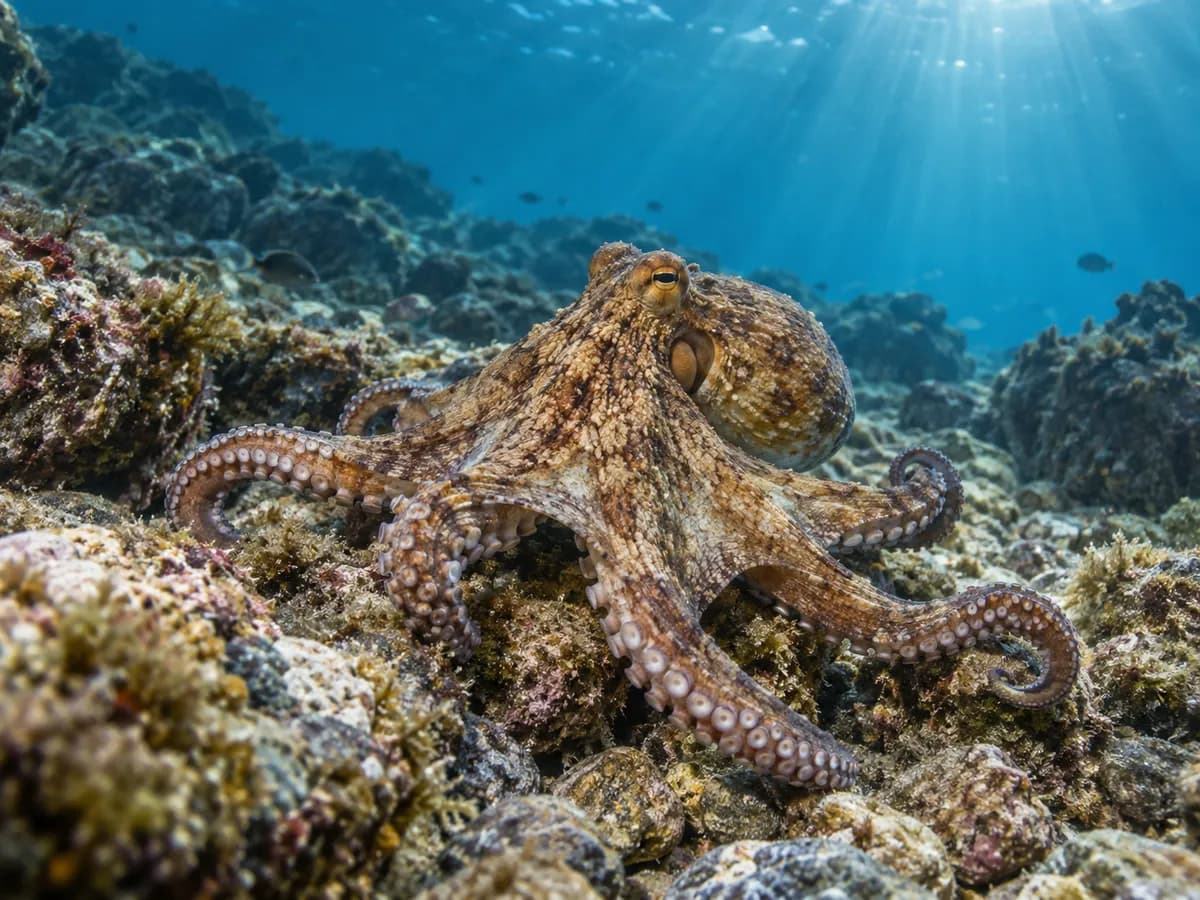
With eight arms, colour-changing skin and a talent for solving problems, the octopus is one of the sea's most surprising animals. The common octopus, which also lives off Türkiye's coasts, lives only a year or two.
- लंबाई
- 0.6–1.3 m
- वज़न
- 3–10 kg
- जंगल में आयु
- 1–2 वर्ष
- संरक्षण स्थिति (IUCN)
- कम चिंताजनक (LC)
मान वयस्कों के लिए अनुमानित हैं और लिंग, उप-प्रजाति व आबादी के अनुसार बदलते हैं।
एक नज़र में
सामान्य ऑक्टोपस के बारे में मुख्य तथ्य।
- Where does it live?It lives on rocky and stony bottoms near the coast in temperate and warm seas, especially the Mediterranean and eastern Atlantic.
- What does it eat?It is a carnivore that eats crabs, mussels, oysters and other shellfish, as well as small fish.
- Behaviour and social lifeOctopuses live alone and usually hide in a den among rocks.
- YoungThe female hangs thousands of tiny eggs from the ceiling of a den and cleans and guards them for weeks without eating.
विस्तार से
संक्षेप में
- The octopus has eight arms and three hearts.
- It can change the colour and texture of its skin in seconds.
- It is known for its problem-solving and learning abilities.
- It lives along Türkiye's coasts, especially in the Aegean and Mediterranean.
- It usually lives only 1–2 years; the female dies after guarding her eggs.
The common octopus (Octopus vulgaris) is a soft-bodied, boneless sea animal belonging to the cephalopods. Each of its eight arms has hundreds of suckers. A large share of its nerve cells are in its arms, which allows the arms to act somewhat on their own.
Where does it live?
It lives on rocky and stony bottoms near the coast in temperate and warm seas, especially the Mediterranean and eastern Atlantic. In Türkiye it is common along the Aegean and Mediterranean coasts.
What does it eat?
It is a carnivore that eats crabs, mussels, oysters and other shellfish, as well as small fish. It can open hard shells with its beak and special secretions.
Behaviour and social life
Octopuses live alone and usually hide in a den among rocks. When in danger they squirt ink and escape. Special cells in their skin let them change colour and texture to blend in. Laboratory and field observations show that octopuses can open jars, solve mazes and learn from experience.
Young
The female hangs thousands of tiny eggs from the ceiling of a den and cleans and guards them for weeks without eating. She dies shortly after the eggs hatch. The young drift in open water as plankton for a while.
Conservation status
The common octopus is listed as Least Concern (LC) on the IUCN Red List. It is commercially important, and heavy fishing can put pressure on populations in some areas.
Fun facts
- Octopus blood is blue because of a copper-based protein.
- A lost arm can grow back over time.
- Having no bones, they can squeeze through any gap larger than their beak.
मिलते-जुलते जानवर
उसी समूह के अन्य जानवर।
प्रकृति का सम्मान, मज़बूत कल
वन्यजीवों की रक्षा हम सबकी ज़िम्मेदारी है।
अगर आपको कोई घायल या छोटा वन्य जानवर मिले तो उसे न छुएँ और स्थानीय प्रकृति संरक्षण विभाग को सूचित करें। अधिक ज्ञान, अधिक जागरूकता।
- प्राकृतिक आवासों का सम्मान करें
- वन्य जानवरों को दूर से देखें
- प्रकृति में कचरा न छोड़ें
- टिकाऊ भविष्य का समर्थन करें