

Eurasian eagle-owls
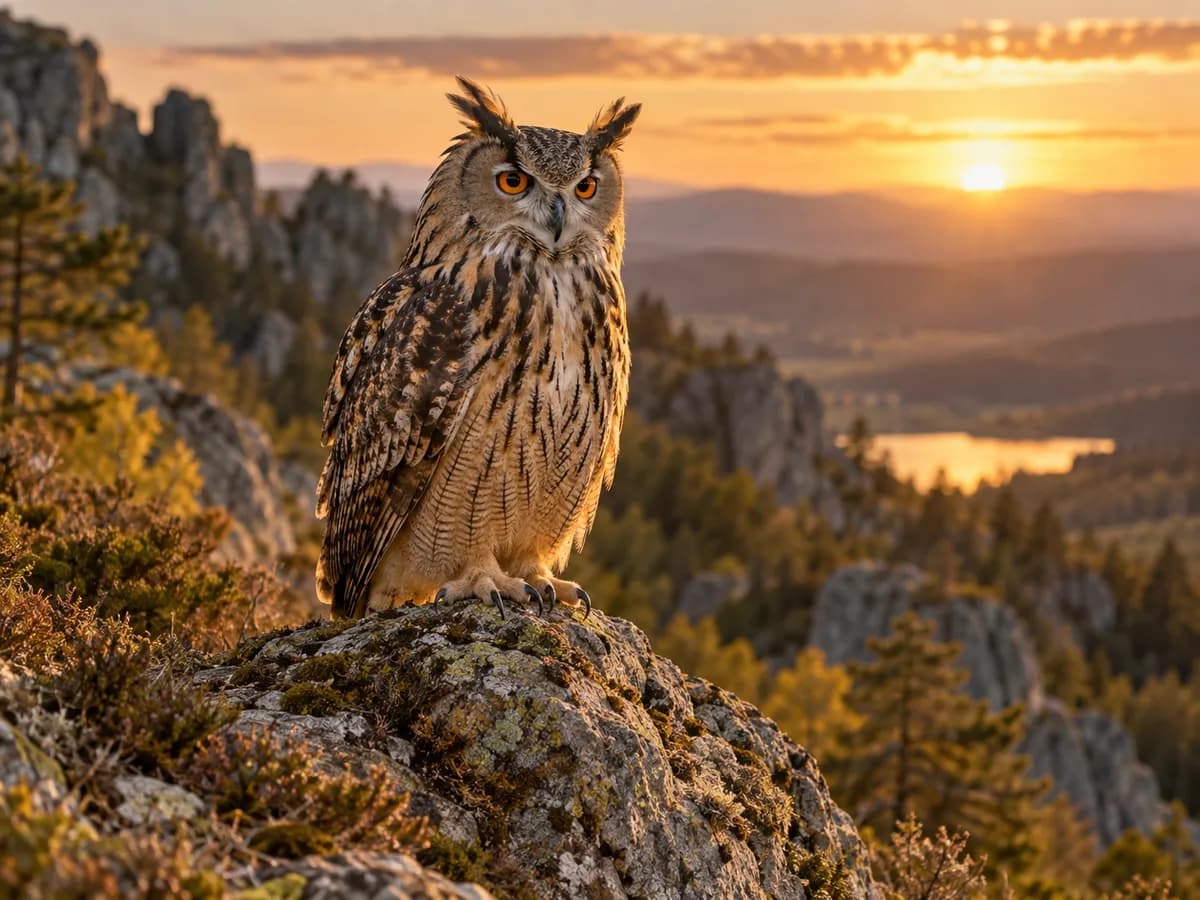
One of the world's largest owls, the Eurasian eagle-owl is known for its orange eyes and ear-like tufts. It lives in rocky and mountainous areas of Türkiye.
- Envergadura
- 1,4–1,9 m
- Peso
- 1,5–4,2 kg
- Longevidade na natureza
- 15–20 anos
- Estado de conservação (UICN)
- Pouco preocupante (LC)
Valores aproximados para adultos; variam com o sexo, a subespécie e a população.
Num relance
Os factos principais sobre Bufos-reais.
- Where does it live?It lives across a large area from Europe to Asia and North Africa.
- What does it eat?It is a carnivore that catches a wide range of prey: mice, rats, hares, hedgehogs, birds and sometimes other owls.
- Behaviour and social lifeEagle-owls are mostly active at dusk and at night.
- ChicksThey usually nest on rock ledges, in cave mouths or in old nests of other birds.
Em detalhe
Em resumo
- The Eurasian eagle-owl is one of the largest owl species in the world.
- The "ears" on its head are actually tufts of feathers.
- It hunts at night and approaches prey unnoticed thanks to its silent flight.
- In Türkiye it lives in rocky valleys, mountains and woodland.
- The IUCN lists it as Least Concern.
The Eurasian eagle-owl (Bubo bubo) is one of the world's largest owls, recognisable by its heavy body, bright orange eyes and long ear tufts. Its deep "oo-hu" call is where its Turkish name, puhu, comes from.
Where does it live?
It lives across a large area from Europe to Asia and North Africa. It prefers cliffs, narrow valleys, mountain slopes and places where forest meets open ground. In Türkiye it is found in rocky and mountainous areas in many regions.
What does it eat?
It is a carnivore that catches a wide range of prey: mice, rats, hares, hedgehogs, birds and sometimes other owls. It usually waits on a perch and glides silently down on prey when it spots it.
Behaviour and social life
Eagle-owls are mostly active at dusk and at night. Pairs stay together for a long time and announce their territory with calls. The special structure of their feathers lets them fly almost silently.
Chicks
They usually nest on rock ledges, in cave mouths or in old nests of other birds. The female usually lays 2–4 eggs and incubates them, while the male brings food to her and the chicks.
Conservation status
The Eurasian eagle-owl is listed as Least Concern (LC) on the IUCN Red List. Collisions with and electrocution on power lines, illegal killing and disturbance at nests are significant causes of death in some regions.
Fun facts
- Owls can turn their heads up to 270 degrees.
- Their eyes are fixed in their sockets, so they must turn their heads to look around.
- The eagle-owl's ear tufts are thought to help signal mood and intent.
Animais semelhantes
Outros animais do mesmo grupo.



Respeito pela natureza, amanhãs mais fortes
Proteger a vida selvagem é responsabilidade de todos.
Se encontrar um animal selvagem ferido ou uma cria, não lhe toque e avise a autoridade local de conservação da natureza. Mais conhecimento, mais consciência.
- Respeite os habitats naturais
- Observe os animais à distância
- Não deixe lixo na natureza
- Apoie um futuro sustentável