

Blue whales
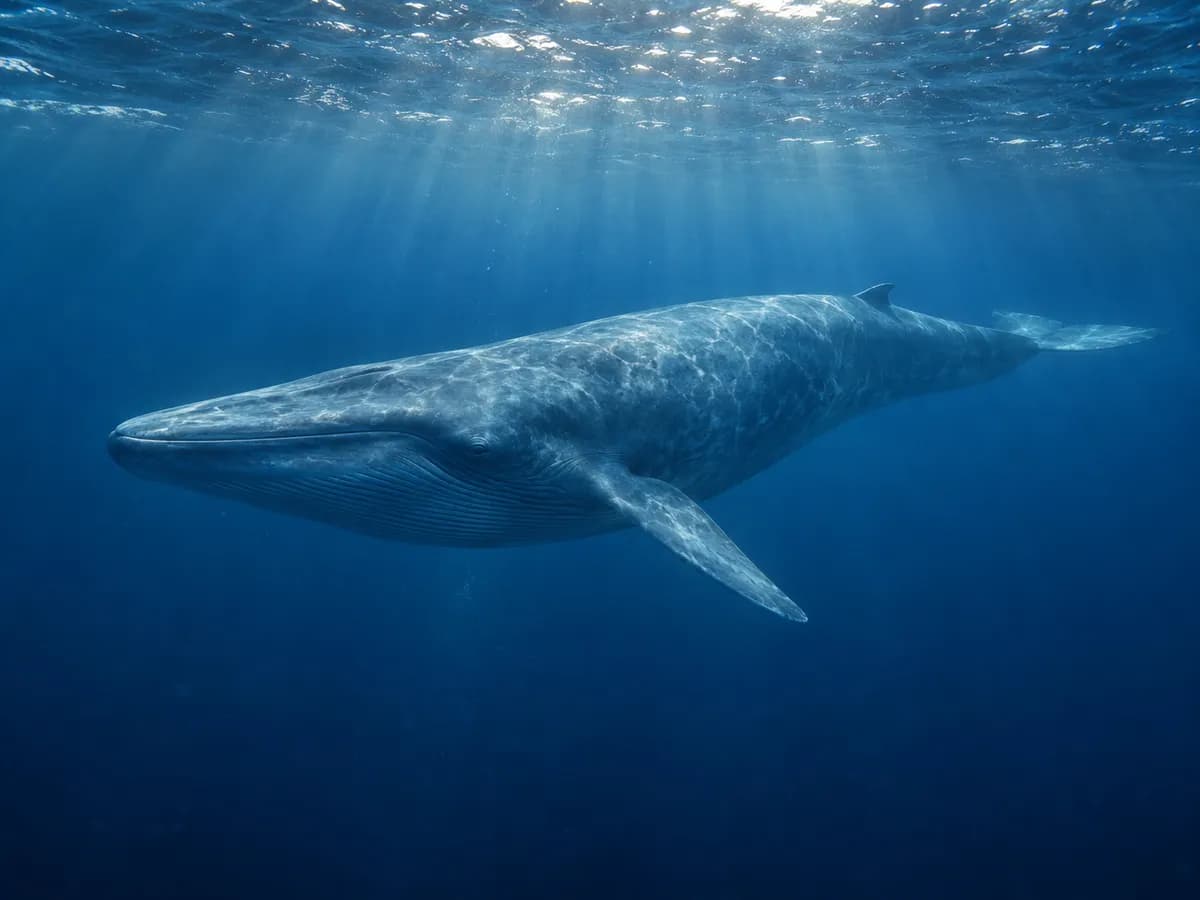
The largest animal known to have ever lived, the blue whale feeds by filtering tiny krill despite its size. It is still recovering from intensive whaling.
- Lengte
- 20–30 m
- Gewicht
- 50–150 t
- Levensduur in het wild
- 80–90 jaar
- Beschermingsstatus (IUCN)
- Bedreigd (EN)
Waarden zijn bij benadering voor volwassen dieren en verschillen per geslacht, ondersoort en populatie.
In één oogopslag
De belangrijkste feiten over Blauwe vinvissen.
- Where does it live?Blue whales live in all the world's oceans, from polar waters to tropical seas.
- What does it eat?It feeds almost exclusively on krill, small shrimp-like crustaceans.
- Behaviour and social lifeBlue whales are usually seen alone or in small groups.
- CalvesPregnancy lasts about 11–12 months and a single calf is born.
Uitgebreid
In het kort
- The blue whale is the largest animal known, bigger even than the dinosaurs.
- It feeds almost only on small crustaceans called krill.
- The "baleen" plates in its mouth work like a sieve.
- The low-frequency sounds it makes can travel very long distances.
- The IUCN lists it as Endangered; 20th-century commercial whaling greatly reduced its numbers.
The blue whale (Balaenoptera musculus) can reach 30 metres in length and more than 150 tonnes, making it the largest animal known to have lived on Earth. Underwater it looks bluish-grey. It has no teeth; instead its mouth holds plates made of keratin called baleen.
Where does it live?
Blue whales live in all the world's oceans, from polar waters to tropical seas. Many populations migrate seasonally between feeding and breeding areas.
What does it eat?
It feeds almost exclusively on krill, small shrimp-like crustaceans. It opens its mouth to take in huge amounts of water and krill, then pushes the water out through its baleen plates, keeping the krill inside. During the feeding season it can eat several tonnes of krill a day.
Behaviour and social life
Blue whales are usually seen alone or in small groups. The very low-frequency sounds they make can travel hundreds of kilometres through the ocean and are thought to be used for communication.
Calves
Pregnancy lasts about 11–12 months and a single calf is born. Even at birth the calf weighs several tonnes, and it grows quickly on its mother's very fat-rich milk.
Conservation status
The blue whale is listed as Endangered (EN) on the IUCN Red List. Commercial whaling in the 20th century greatly reduced populations, especially in the Antarctic. Since commercial whaling was banned, some populations have been slowly recovering. Ship strikes, entanglement and ocean noise are the main threats today.
Fun facts
- A blue whale's heart can be the size of a small car.
- The spout of vapour it blows when exhaling rises several metres high.
- Baleen plates are made of keratin, the same material as human fingernails.
Vergelijkbare dieren
Andere dieren uit dezelfde groep.
Respect voor de natuur, een sterkere toekomst
Wilde dieren beschermen is ieders verantwoordelijkheid.
Vind je een gewond of jong wild dier, raak het dan niet aan en waarschuw de plaatselijke natuurbeschermingsdienst. Meer kennis, meer bewustzijn.
- Respecteer natuurlijke leefgebieden
- Bekijk wilde dieren van een afstand
- Laat geen afval achter in de natuur
- Steun een duurzame toekomst