

White storks
Known as a herald of spring, the white stork migrates thousands of kilometres between Africa and Europe every year. Türkiye lies at a key point on the stork's migration route.
- Spanwijdte
- 1,6–2,2 m
- Gewicht
- 2,3–4,5 kg
- Levensduur in het wild
- 20–30 jaar
- Beschermingsstatus (IUCN)
- Niet bedreigd (LC)
Waarden zijn bij benadering voor volwassen dieren en verschillen per geslacht, ondersoort en populatie.
In één oogopslag
De belangrijkste feiten over Ooievaars.
- Where does it live?It breeds across most of Europe, North Africa and western Asia and spends the winter in Africa south of the Sahara.
- What does it eat?It is a carnivore that eats frogs, fish, insects, earthworms, lizards and small mammals.
- MigrationDuring migration, storks rise and soar on warm air currents instead of flapping.
- ChicksPairs return to the same nest every year and add to it; some nests are used for many years.
Uitgebreid
In het kort
- The white stork makes a long migration between Europe and Africa every year.
- During migration it soars on rising warm air currents.
- Huge flocks pass over Türkiye, especially over the Bosphorus and the Belen Pass.
- It builds large nests on roofs, chimneys and poles.
- The IUCN lists it as Least Concern.
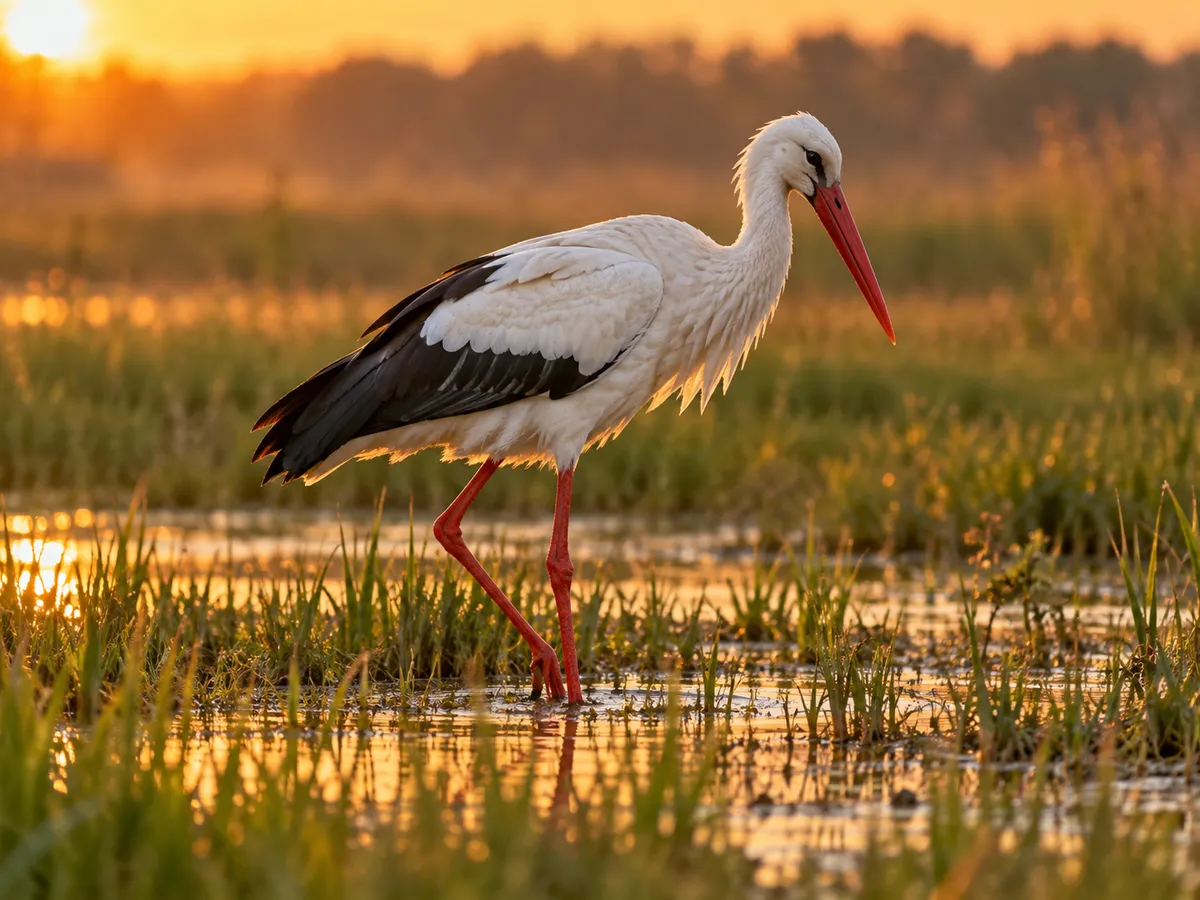
The white stork (Ciconia ciconia) is a large bird with white plumage, black wingtips and a long red bill and legs. It does not sing like songbirds; instead it makes a clattering sound by rapidly opening and closing its bill.
Where does it live?
It breeds across most of Europe, North Africa and western Asia and spends the winter in Africa south of the Sahara. It uses wetlands, meadows and farmland. It breeds in many parts of Türkiye, which is also one of the most important points on the migration route from Europe to Africa.
What does it eat?
It is a carnivore that eats frogs, fish, insects, earthworms, lizards and small mammals. It usually searches for food by walking through wet meadows and freshly ploughed fields.
Migration
During migration, storks rise and soar on warm air currents instead of flapping. That is why they avoid long sea crossings and use narrow straits such as Gibraltar and the Bosphorus. In autumn, tens of thousands of storks pass over the Bosphorus and the Belen Pass in Hatay.
Chicks
Pairs return to the same nest every year and add to it; some nests are used for many years. The female usually lays 3–5 eggs, and both parents incubate and feed the chicks.
Conservation status
The white stork is listed as Least Concern (LC) on the IUCN Red List. In the 20th century its numbers fell in some European countries but have since risen in many areas thanks to conservation. Collisions with power lines, drained wetlands and pesticides are still important threats.
Fun facts
- The legend that storks "deliver babies" is told in many European countries.
- Some storks are tracked with satellite transmitters to study their migration routes.
- Their nests sometimes become "apartment blocks" that also house smaller birds.
Vergelijkbare dieren
Andere dieren uit dezelfde groep.

Respect voor de natuur, een sterkere toekomst
Wilde dieren beschermen is ieders verantwoordelijkheid.
Vind je een gewond of jong wild dier, raak het dan niet aan en waarschuw de plaatselijke natuurbeschermingsdienst. Meer kennis, meer bewustzijn.
- Respecteer natuurlijke leefgebieden
- Bekijk wilde dieren van een afstand
- Laat geen afval achter in de natuur
- Steun een duurzame toekomst