

King cobras
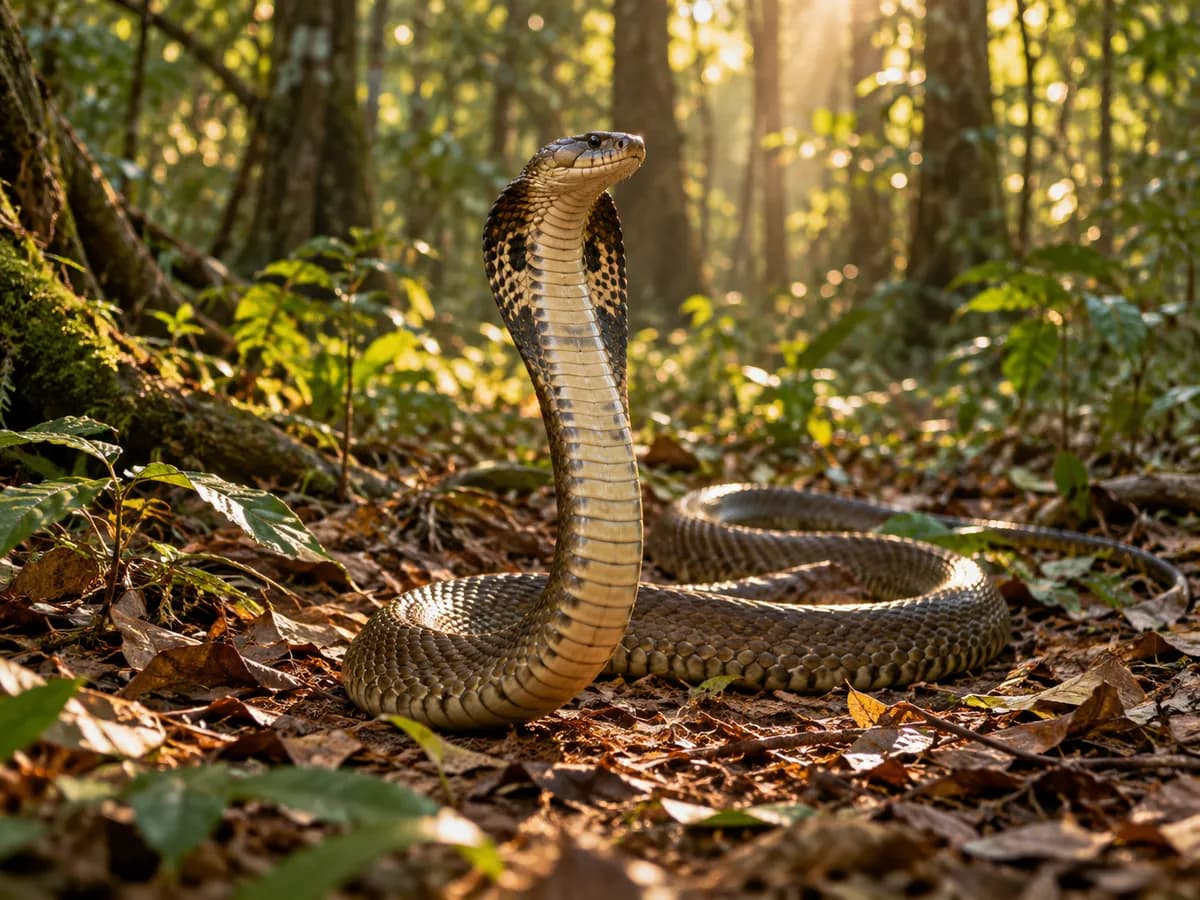
The world's longest venomous snake, the king cobra warns intruders by raising its head off the ground and spreading its hood. Most of its diet is other snakes.
- Lengte
- 3–5,5 m
- Gewicht
- 5–12 kg
- Levensduur in het wild
- 15–20 jaar
- Beschermingsstatus (IUCN)
- Kwetsbaar (VU)
Waarden zijn bij benadering voor volwassen dieren en verschillen per geslacht, ondersoort en populatie.
In één oogopslag
De belangrijkste feiten over Koningscobra’s.
- Where does it live?It lives from India through Southeast Asia, from southern China to the Philippines and Indonesia.
- What does it eat?Its main prey are other snakes such as rat snakes, pythons and other cobras; it sometimes eats lizards.
- Behaviour and social lifeKing cobras live alone and usually avoid people.
- YoungInstead of laying her eggs on the ground, the female builds a nest of leaves and twigs and usually guards it for a time.
Uitgebreid
In het kort
- The king cobra is the world's longest venomous snake.
- Its main food is other snakes.
- The female is one of very few snakes that builds a nest of leaves for its eggs.
- When threatened it raises the front of its body and spreads its hood.
- The IUCN lists it as Vulnerable; deforestation and hunting are the main threats.
The king cobra (Ophiophagus hannah) can grow longer than 5 metres, making it the world's longest venomous snake. Its scientific name Ophiophagus means "snake eater". Despite its name, it belongs to a different genus from other cobras. Recent genetic studies suggest king cobras may actually be several species.
Where does it live?
It lives from India through Southeast Asia, from southern China to the Philippines and Indonesia. It prefers rainforests, dense forests, bamboo thickets and the edges of wetlands.
What does it eat?
Its main prey are other snakes such as rat snakes, pythons and other cobras; it sometimes eats lizards. Its powerful neurotoxic venom quickly paralyses prey. After a large meal it can go a long time without eating.
Behaviour and social life
King cobras live alone and usually avoid people. When threatened, it raises the front of its body, spreads its hood and makes a deep, growl-like hiss. This display is often a warning before any strike.
Young
Instead of laying her eggs on the ground, the female builds a nest of leaves and twigs and usually guards it for a time. Hatchlings are venomous and independent.
Conservation status
The king cobra is listed as Vulnerable (VU) on the IUCN Red List. Deforestation, hunting for skins and traditional medicine, and killing out of fear are the main threats.
Fun facts
- Its venom is very potent, but bites are rare; it usually prefers to escape.
- It can lift its head up to the eye level of a standing adult.
- Snakes smell with their tongues; the forked tongue collects chemical traces from the air.
Goed om te weten
De belangrijkste punten.
- Keep away from wild animalsNever handle or try to catch venomous snakes. In case of a snakebite, call emergency services immediately.
Vergelijkbare dieren
Andere dieren uit dezelfde groep.
Respect voor de natuur, een sterkere toekomst
Wilde dieren beschermen is ieders verantwoordelijkheid.
Vind je een gewond of jong wild dier, raak het dan niet aan en waarschuw de plaatselijke natuurbeschermingsdienst. Meer kennis, meer bewustzijn.
- Respecteer natuurlijke leefgebieden
- Bekijk wilde dieren van een afstand
- Laat geen afval achter in de natuur
- Steun een duurzame toekomst