
Red kangaroos
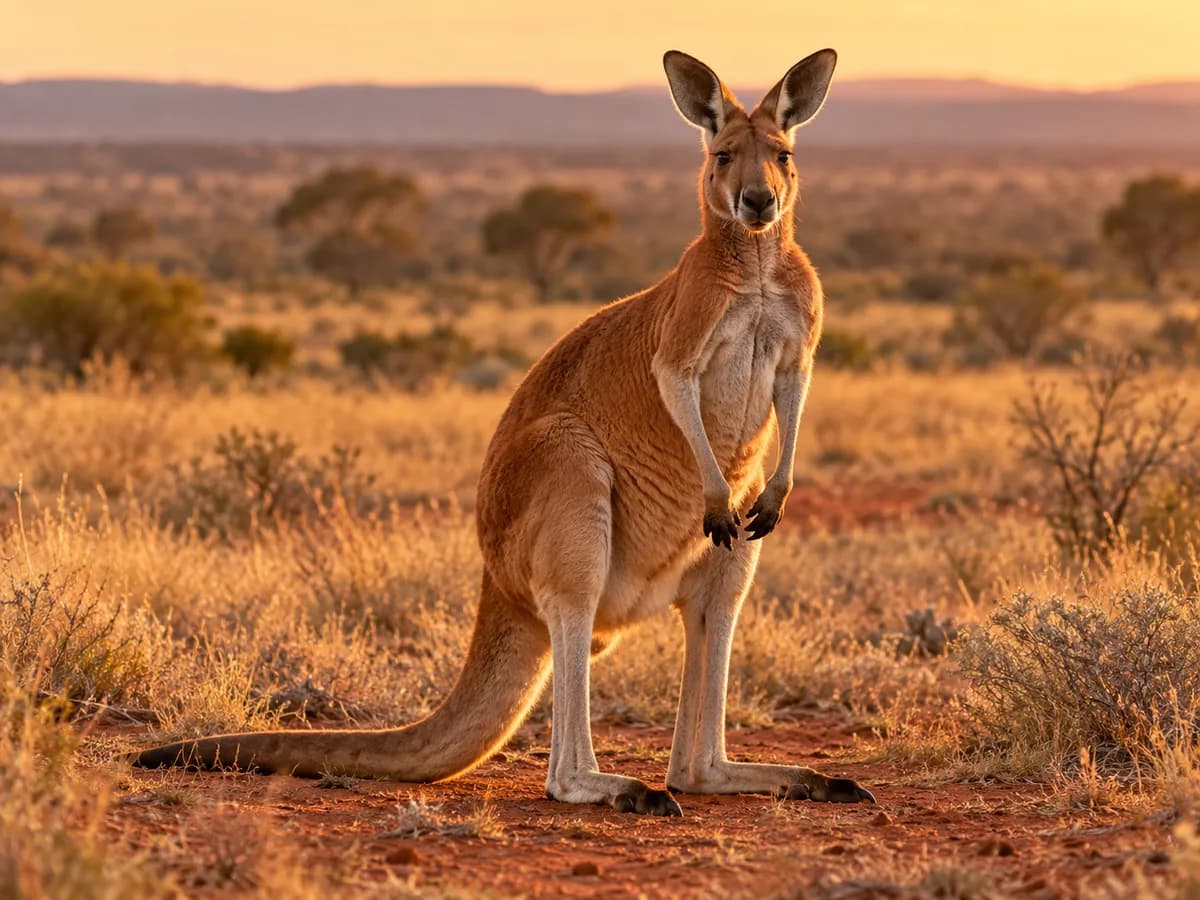
The largest of all marsupials, the red kangaroo covers long distances by hopping on its powerful hind legs. It is a symbol of Australia's dry interior.
- Lengte
- 1–1,6 m
- Gewicht
- 20–90 kg
- Levensduur in het wild
- 8–12 jaar
- Beschermingsstatus (IUCN)
- Niet bedreigd (LC)
Waarden zijn bij benadering voor volwassen dieren en verschillen per geslacht, ondersoort en populatie.
In één oogopslag
De belangrijkste feiten over Rode reuzenkangoeroes.
- Where does it live?It lives in the arid and semi-arid grasslands, open plains and shrublands of inland Australia.
- What does it eat?It is a herbivore that eats grass and other green plants.
- Behaviour and social lifeRed kangaroos live in loose groups called mobs.
- JoeysAfter a short pregnancy of about 33 days, the female gives birth to a tiny, hairless young.
Uitgebreid
In het kort
- The red kangaroo is the largest living marsupial.
- It moves by hopping on its powerful hind legs; its tail provides balance.
- It is a herbivore that needs little water.
- The joey grows for months in its mother's pouch after birth.
- The IUCN lists it as Least Concern.
The red kangaroo (Osphranter rufus) is the largest living marsupial. Males usually have reddish-brown fur, while females are often more bluish-grey. Its powerful hind legs and long, thick tail let it move by hopping.
Where does it live?
It lives in the arid and semi-arid grasslands, open plains and shrublands of inland Australia.
What does it eat?
It is a herbivore that eats grass and other green plants. Thanks to the moisture in plants, it can go a long time without drinking. It rests in the shade during the hottest hours and feeds when it is cooler.
Behaviour and social life
Red kangaroos live in loose groups called mobs. Males "box" for the right to mate with females, rising up on their hind legs, leaning on their tails and kicking. Hopping is energy-efficient at high speeds.
Joeys
After a short pregnancy of about 33 days, the female gives birth to a tiny, hairless young. It climbs into the pouch on its own, attaches to a teat and grows there for months. Females can pause an embryo's development until conditions are right.
Conservation status
The red kangaroo is listed as Least Concern (LC) on the IUCN Red List. Its numbers vary greatly from year to year depending on rainfall. In Australia it is subject to a regulated management programme.
Fun facts
- A baby kangaroo is called a joey.
- Kangaroos cannot walk backwards.
- A female can have a young joey out of the pouch, a joey in the pouch and a paused embryo at the same time.
Vergelijkbare dieren
Andere dieren uit dezelfde groep.
Respect voor de natuur, een sterkere toekomst
Wilde dieren beschermen is ieders verantwoordelijkheid.
Vind je een gewond of jong wild dier, raak het dan niet aan en waarschuw de plaatselijke natuurbeschermingsdienst. Meer kennis, meer bewustzijn.
- Respecteer natuurlijke leefgebieden
- Bekijk wilde dieren van een afstand
- Laat geen afval achter in de natuur
- Steun een duurzame toekomst