

Moon jellyfish
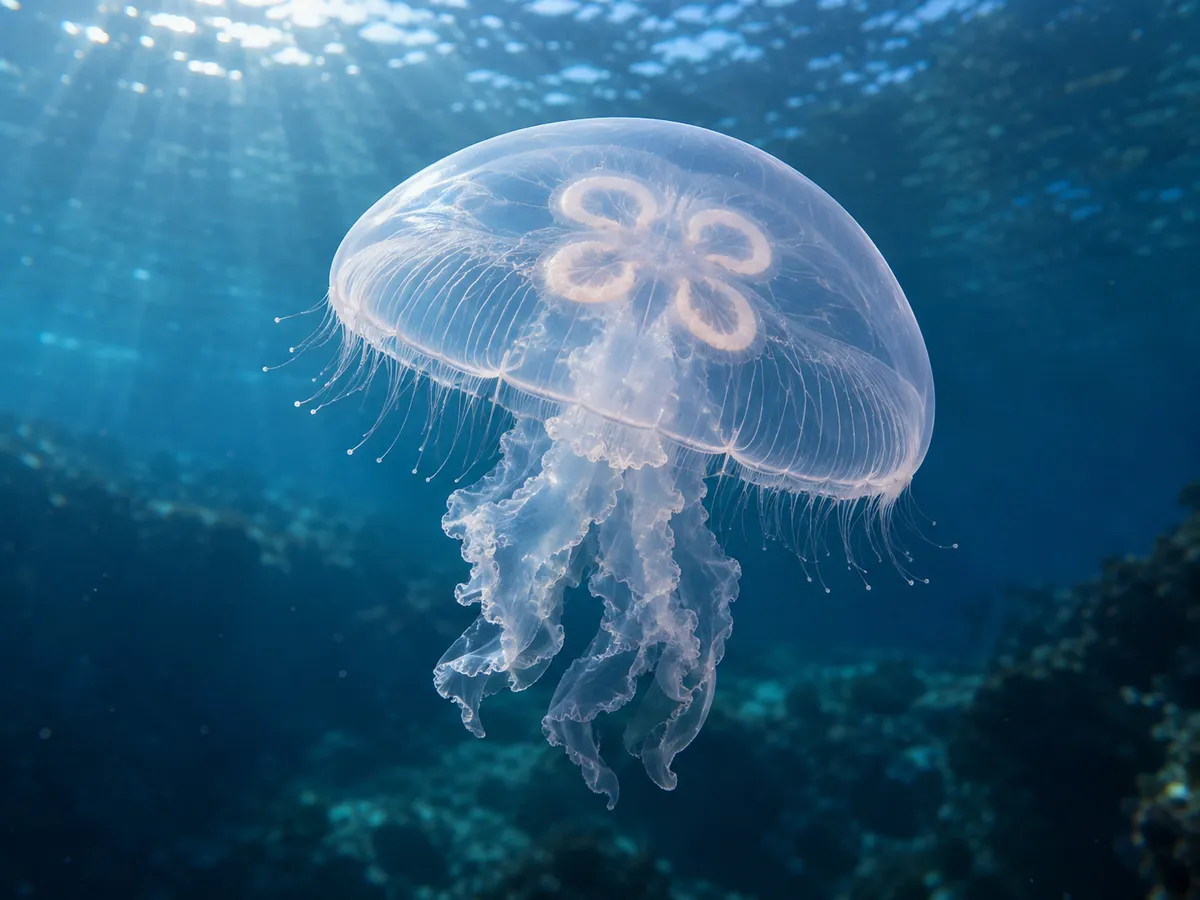
Known for its transparent, umbrella-shaped body and four ring-shaped reproductive organs, the moon jellyfish is one of the most common jellyfish in the world. In Türkiye it is often seen, especially in the Sea of Marmara.
- Диаметр
- 25–40 cm
- Питание
- Фильтратор
- Класс
- Беспозвоночное
Значения приблизительные для взрослых особей и зависят от пола, подвида и популяции.
Коротко
Главные факты: Аурелии.
- Where does it live?It is common in temperate and tropical seas worldwide, especially in coastal waters, bays and harbours.
- What does it eat?It feeds on small organisms such as zooplankton, fish eggs and larvae.
- Behaviour and lifeJellyfish are not strong swimmers; they drift with currents and move slowly by contracting and relaxing their bodies.
- Life cycleAdult jellyfish produce eggs and sperm.
Подробно
Коротко
- The moon jellyfish can be found in almost every sea.
- It has no brain, heart or bones; most of its body is water.
- It feeds on plankton and other tiny animals.
- It has a complex life cycle: egg, larva, polyp and jellyfish stages.
- Its sting is weak and usually harmless to people.
The moon jellyfish (Aurelia aurita) is recognisable by its semi-transparent, disc-shaped body. In the middle of the body are four ring-shaped reproductive organs that stand out in the light and give it a "moon-like" look.
Where does it live?
It is common in temperate and tropical seas worldwide, especially in coastal waters, bays and harbours. In Türkiye it occurs in the Marmara, Black, Aegean and Mediterranean seas; in some years it forms very dense swarms in the Sea of Marmara.
What does it eat?
It feeds on small organisms such as zooplankton, fish eggs and larvae. It catches food with short tentacles around the edge of its bell and with mucus on its body surface, then moves it to its mouth.
Behaviour and life
Jellyfish are not strong swimmers; they drift with currents and move slowly by contracting and relaxing their bodies. Their numbers can rise quickly when food is plentiful and the water is warm.
Life cycle
Adult jellyfish produce eggs and sperm. After fertilisation, larvae settle on the sea floor and turn into small polyps. Under the right conditions, polyps release tiny jellyfish. Thanks to this complex cycle, polyps can sometimes live for a long time.
Conservation status
There is no global IUCN assessment for the moon jellyfish. Overfishing, pollution and warming seas are thought to increase jellyfish blooms in some areas.
Fun facts
- More than about 95 percent of a moon jellyfish's body is water.
- Although it has no brain, a nerve net lets it respond to light and touch.
- Sea turtles eat jellyfish, which is why plastic bags in the sea are dangerous for turtles.
Полезно знать
Самое важное.
- Don't touch jellyfishThe moon jellyfish's sting is usually mild but can cause redness and itching in sensitive people. Do not touch jellyfish washed up on the shore either.
Похожие животные
Другие животные из той же группы.
Уважение к природе — сильнее завтра
Защита дикой природы — общая ответственность.
Если вы нашли раненое или детёныша дикого животного, не трогайте его и сообщите в местную службу охраны природы. Больше знаний — больше осознанности.
- Уважайте природные места обитания
- Наблюдайте за животными издалека
- Не оставляйте мусор на природе
- Поддерживайте устойчивое будущее