

Komodo dragons
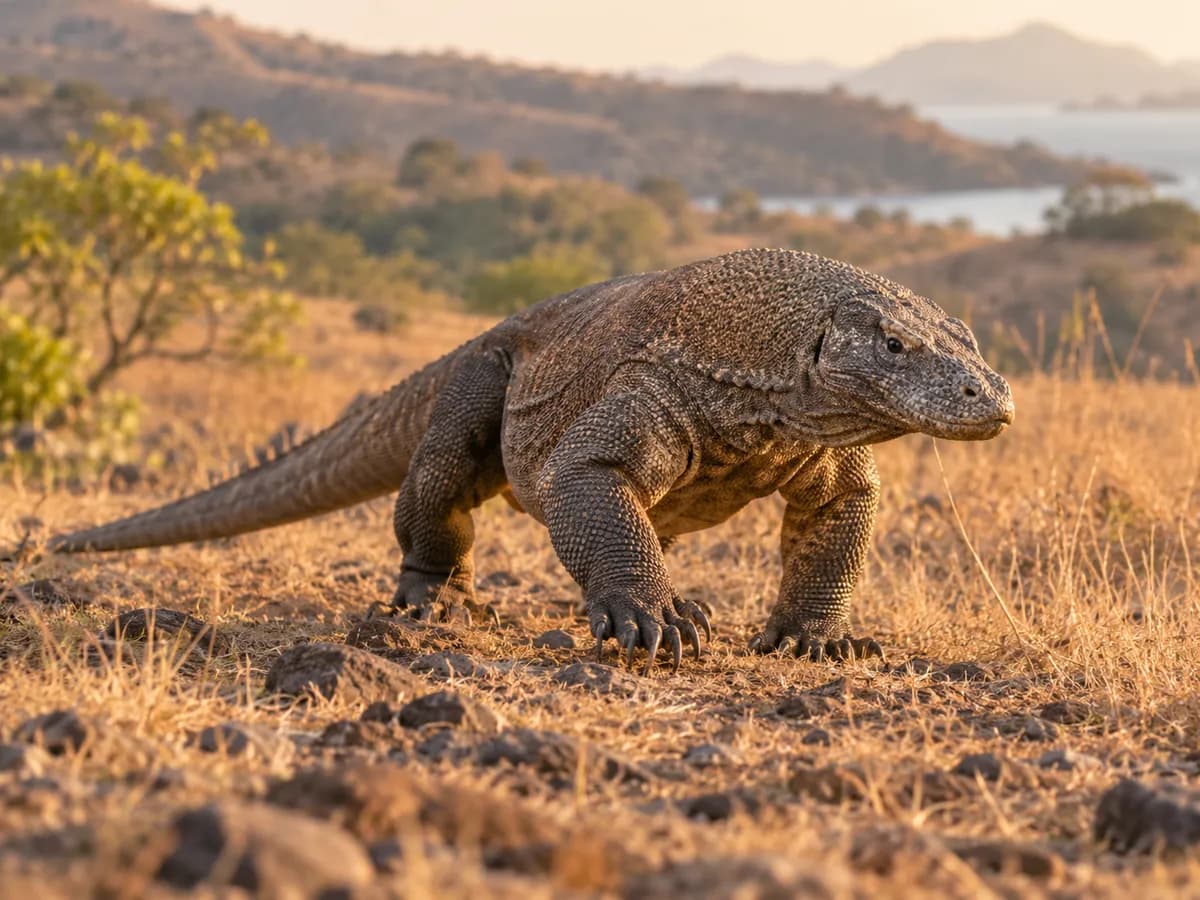
The world's largest lizard, the Komodo dragon is a powerful predator that lives on a few Indonesian islands. Venom in its bite helps weaken its prey.
- Länge
- 2–3 m
- Gewicht
- 50–90 kg
- Lebenserwartung in freier Natur
- 25–30 Jahre
- Gefährdungsstatus (IUCN)
- Stark gefährdet (EN)
Die Werte gelten ungefähr für erwachsene Tiere und schwanken je nach Geschlecht, Unterart und Population.
Auf einen Blick
Die wichtigsten Fakten über Komodowarane.
- Where does it live?It lives only in Indonesia's Lesser Sunda Islands: Komodo, Rinca, Flores and a few small islands.
- What does it eat?It is a carnivore.
- Behaviour and social lifeKomodo dragons mostly live alone, though several may gather at a large carcass.
- YoungThe female buries her eggs in the ground or in old nests.
Ausführlich
Kurz gesagt
- The Komodo dragon is the largest living lizard species.
- It lives only on Komodo, Rinca, Flores and a few small islands in Indonesia.
- It can hunt large animals such as deer and wild boar and also eats carrion.
- Glands in its lower jaw produce venom.
- The IUCN lists it as Endangered; climate change and habitat loss are the main threats.
The Komodo dragon (Varanus komodoensis) can approach 3 metres in length, making it the largest living lizard. With strong legs, a long muscular tail, a forked tongue and serrated teeth, it is the top predator on its islands.
Where does it live?
It lives only in Indonesia's Lesser Sunda Islands: Komodo, Rinca, Flores and a few small islands. It uses dry savannas, open woodland and coastal areas. A large part of its population is protected in Komodo National Park.
What does it eat?
It is a carnivore. Young dragons eat insects, lizards and birds. Adults can hunt large animals such as deer, wild boar and water buffalo. It ambushes prey and wounds it with a powerful bite. Using its forked tongue to pick up scent traces in the air, it can find carcasses from far away.
Behaviour and social life
Komodo dragons mostly live alone, though several may gather at a large carcass. They rest in the shade or in burrows during the hottest hours. Young dragons spend much of their first years in trees to stay safe from adults.
Young
The female buries her eggs in the ground or in old nests. The young hatch after about 7–8 months and are independent. Female Komodo dragons have been documented producing young from unfertilised eggs without a male (parthenogenesis).
Conservation status
The Komodo dragon is listed as Endangered (EN) on the IUCN Red List. Its very small range, the risk that rising sea levels will shrink its habitat, declining prey and human activity are the main threats.
Fun facts
- The venom in a Komodo dragon's bite is thought to increase blood loss and hinder clotting.
- It can eat a large fraction of its own body weight in a single meal.
- It is named after Komodo, one of the islands where it lives.
Gut zu wissen
Die wichtigsten Punkte.
- Keep away from wild animalsKomodo dragons can be dangerous to people too. In the national park, only walk with a guide and follow the rules.
Ähnliche Tiere
Weitere Tiere aus derselben Gruppe.
Respekt vor der Natur, ein stärkeres Morgen
Wildtiere zu schützen ist unser aller Verantwortung.
Wenn Sie ein verletztes oder junges Wildtier finden, fassen Sie es nicht an und informieren Sie die örtliche Naturschutzbehörde. Mehr Wissen, mehr Bewusstsein.
- Natürliche Lebensräume respektieren
- Wildtiere aus der Ferne beobachten
- Keinen Müll in der Natur lassen
- Eine nachhaltige Zukunft unterstützen