

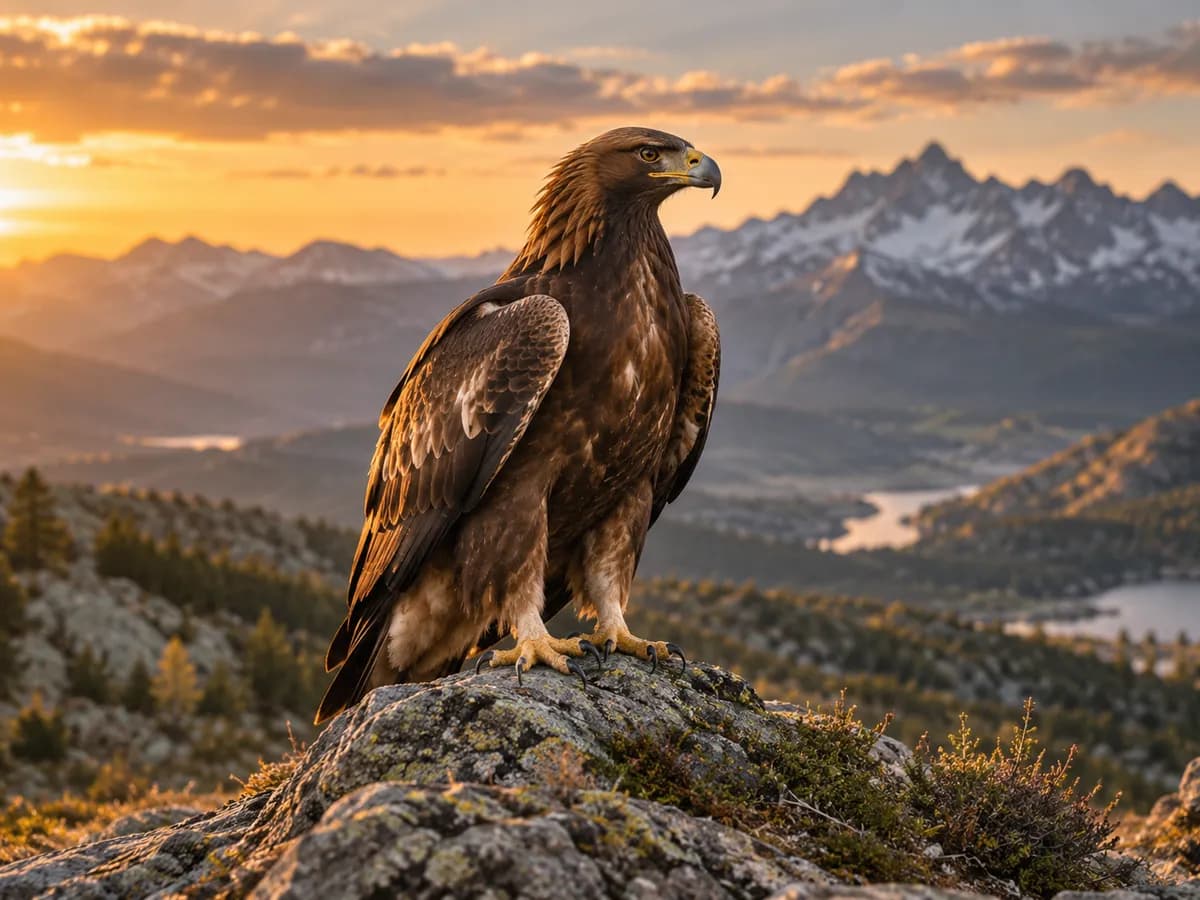
- Flügelspannweite
- 1,8–2,3 m
- Gewicht
- 3–6,7 kg
- Lebenserwartung in freier Natur
- 20–30 Jahre
- Gefährdungsstatus (IUCN)
- Nicht gefährdet (LC)
Die Werte gelten ungefähr für erwachsene Tiere und schwanken je nach Geschlecht, Unterart und Population.
Auf einen Blick
Die wichtigsten Fakten über Steinadler.
- Where does it live?It lives in North America, Europe, Asia and North Africa, in mountains, rocky valleys, steppes and open country.
- What does it eat?It is a carnivore that feeds on mammals such as hares, ground squirrels and voles, as well as birds.
- Behaviour and social lifeGolden eagles usually stay with the same mate for life and hold large territories.
- ChicksThe female usually lays 1–3 eggs.
Ausführlich
Kurz gesagt
- The golden eagle is the most widespread eagle in the Northern Hemisphere.
- It is named for the golden-brown feathers on the back of its head.
- It catches prey such as hares, ground squirrels and birds in a dive.
- In Türkiye it breeds in mountainous and rocky areas.
- The IUCN lists it as Least Concern.
The golden eagle (Aquila chrysaetos) is a large bird of prey recognisable by its dark brown plumage and golden nape feathers. Its wingspan can exceed 2 metres. In many cultures it is a symbol of strength and freedom.
Where does it live?
It lives in North America, Europe, Asia and North Africa, in mountains, rocky valleys, steppes and open country. In Türkiye it breeds especially in mountainous and rocky areas.
What does it eat?
It is a carnivore that feeds on mammals such as hares, ground squirrels and voles, as well as birds. It sometimes takes larger animals such as young goats or deer, and eats carrion in winter. It finds prey while soaring high and catches it with a fast dive.
Behaviour and social life
Golden eagles usually stay with the same mate for life and hold large territories. Pairs may use several nests on steep cliffs or big trees in rotation for years. They mark their territories with undulating display flights.
Chicks
The female usually lays 1–3 eggs. The larger chick competes with the smaller one, and often only one chick survives to fledging.
Conservation status
The golden eagle is listed as Least Concern (LC) on the IUCN Red List. Collisions with power lines and wind turbines, poisoning (especially lead poisoning), illegal killing and disturbance at nests are significant threats in some regions.
Fun facts
- A golden eagle can reach very high speeds while diving.
- In Central Asia, some communities have hunted with golden eagles for centuries.
- Young golden eagles have white patches on their wings and tail that fade with age.
Ähnliche Tiere
Weitere Tiere aus derselben Gruppe.

Respekt vor der Natur, ein stärkeres Morgen
Wildtiere zu schützen ist unser aller Verantwortung.
Wenn Sie ein verletztes oder junges Wildtier finden, fassen Sie es nicht an und informieren Sie die örtliche Naturschutzbehörde. Mehr Wissen, mehr Bewusstsein.
- Natürliche Lebensräume respektieren
- Wildtiere aus der Ferne beobachten
- Keinen Müll in der Natur lassen
- Eine nachhaltige Zukunft unterstützen