

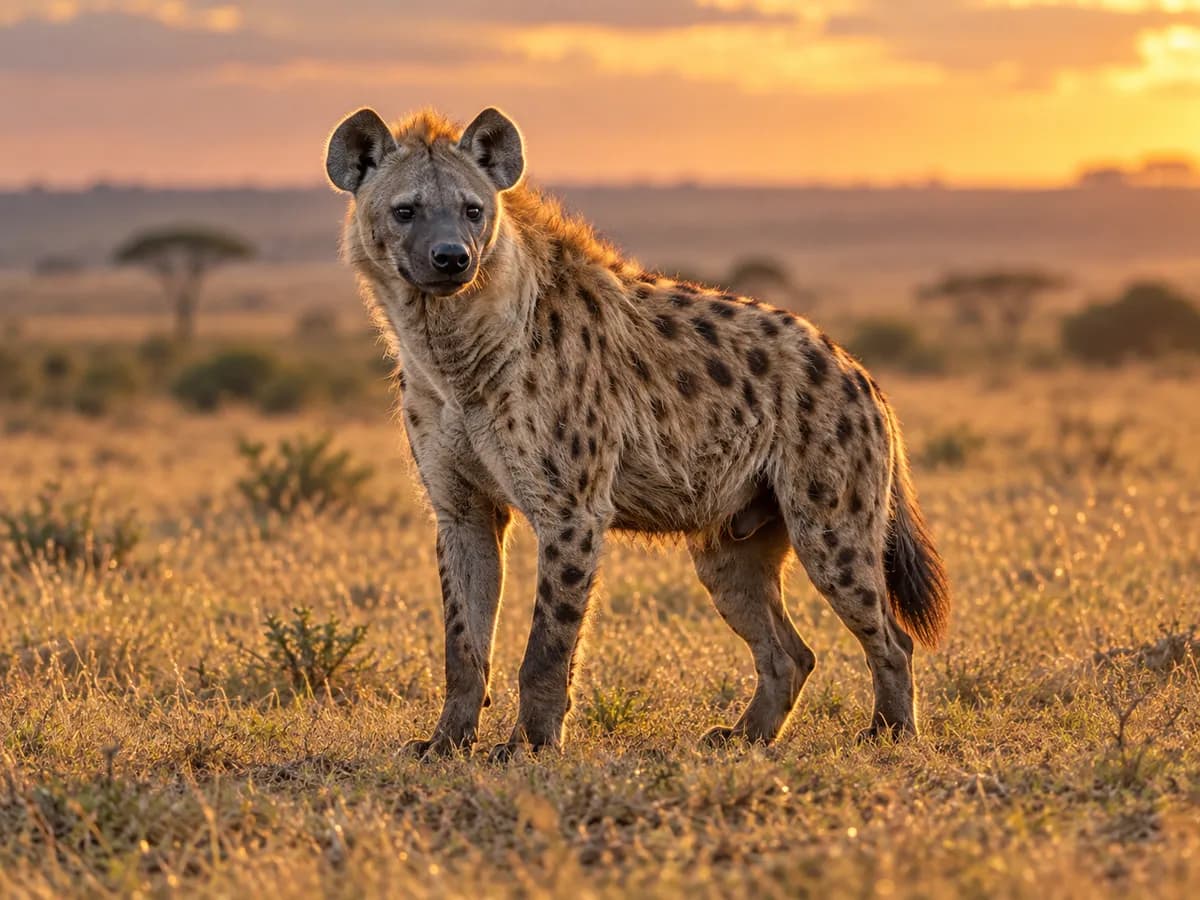
- Länge
- 1–1,7 m
- Gewicht
- 40–86 kg
- Lebenserwartung in freier Natur
- 12–25 Jahre
- Gefährdungsstatus (IUCN)
- Nicht gefährdet (LC)
Die Werte gelten ungefähr für erwachsene Tiere und schwanken je nach Geschlecht, Unterart und Population.
Auf einen Blick
Die wichtigsten Fakten über Tüpfelhyänen.
- Where does it live?It lives in the savannas, grasslands, semi-deserts and mountains of Africa south of the Sahara.
- What does it eat?It is a carnivore that hunts most of its own prey in groups, mainly herbivores such as antelopes and zebras.
- Behaviour and social lifeSpotted hyenas live in groups called clans that can number dozens of individuals.
- CubsThe female usually has 1–2 cubs in a communal den.
Ausführlich
Kurz gesagt
- The spotted hyena hunts most of its own food; it is not just a scavenger.
- Females are larger than males, and females lead the group.
- With very powerful jaws, it can crack and digest bones.
- Its "laughing" calls signal excitement and tension.
- The IUCN lists it as Least Concern.
The spotted hyena (Crocuta crocuta) is the largest of the hyenas. It is recognisable by its sloping back, strong neck and spotted coat. Although it looks dog-like, it belongs to a group more closely related to cats.
Where does it live?
It lives in the savannas, grasslands, semi-deserts and mountains of Africa south of the Sahara.
What does it eat?
It is a carnivore that hunts most of its own prey in groups, mainly herbivores such as antelopes and zebras. When it gets the chance, it also steals kills from other predators and eats carrion. Its strong jaws and teeth crack bones, and its digestive system can even digest bone.
Behaviour and social life
Spotted hyenas live in groups called clans that can number dozens of individuals. Females dominate clans; even the lowest-ranking female usually outranks males. Rank is often passed from mother to offspring. They have a rich vocal repertoire of whoops, growls and the famous "laugh".
Cubs
The female usually has 1–2 cubs in a communal den. Unlike other carnivores, the cubs are born with their eyes open and their teeth already in. Mothers may nurse their cubs for a long time, more than a year.
Conservation status
The spotted hyena is listed as Least Concern (LC) on the IUCN Red List. Outside protected areas, however, its numbers are falling because of conflict with people, poisoning, snares and habitat loss.
Fun facts
- A hyena's "laugh" is not joy but usually a sign of excitement or tension.
- Because they digest bone, their droppings can be whitish from calcium.
- Spotted hyenas are intelligent, cooperative hunters with a high success rate.
Ähnliche Tiere
Weitere Tiere aus derselben Gruppe.
Respekt vor der Natur, ein stärkeres Morgen
Wildtiere zu schützen ist unser aller Verantwortung.
Wenn Sie ein verletztes oder junges Wildtier finden, fassen Sie es nicht an und informieren Sie die örtliche Naturschutzbehörde. Mehr Wissen, mehr Bewusstsein.
- Natürliche Lebensräume respektieren
- Wildtiere aus der Ferne beobachten
- Keinen Müll in der Natur lassen
- Eine nachhaltige Zukunft unterstützen