

- Höhe
- 1,1–1,5 m
- Gewicht
- 30–90 kg
- Lebenserwartung in freier Natur
- 35–45 Jahre
- Gefährdungsstatus (IUCN)
- Vom Aussterben bedroht (CR)
Die Werte gelten ungefähr für erwachsene Tiere und schwanken je nach Geschlecht, Unterart und Population.
Auf einen Blick
Die wichtigsten Fakten über Orang-Utans.
- Where does it live?Orangutans live only in the rainforests of Borneo and Sumatra in Southeast Asia.
- What does it eat?Most of their diet is fruit; they especially like ripe fruit such as figs.
- Behaviour and social lifeOrangutans are the most solitary of the great apes; apart from mothers and young, they mostly travel alone.
- YoungA female usually has a single young and cares for it for about 7–8 years.
Ausführlich
Kurz gesagt
- Orangutans live only on the islands of Borneo and Sumatra.
- There are three species: Bornean, Sumatran and Tapanuli orangutans.
- Most of their diet is fruit.
- Young stay with their mothers for about 7–8 years, one of the longest periods of care in the animal world.
- All three species are listed as Critically Endangered by the IUCN; deforestation is the biggest threat.
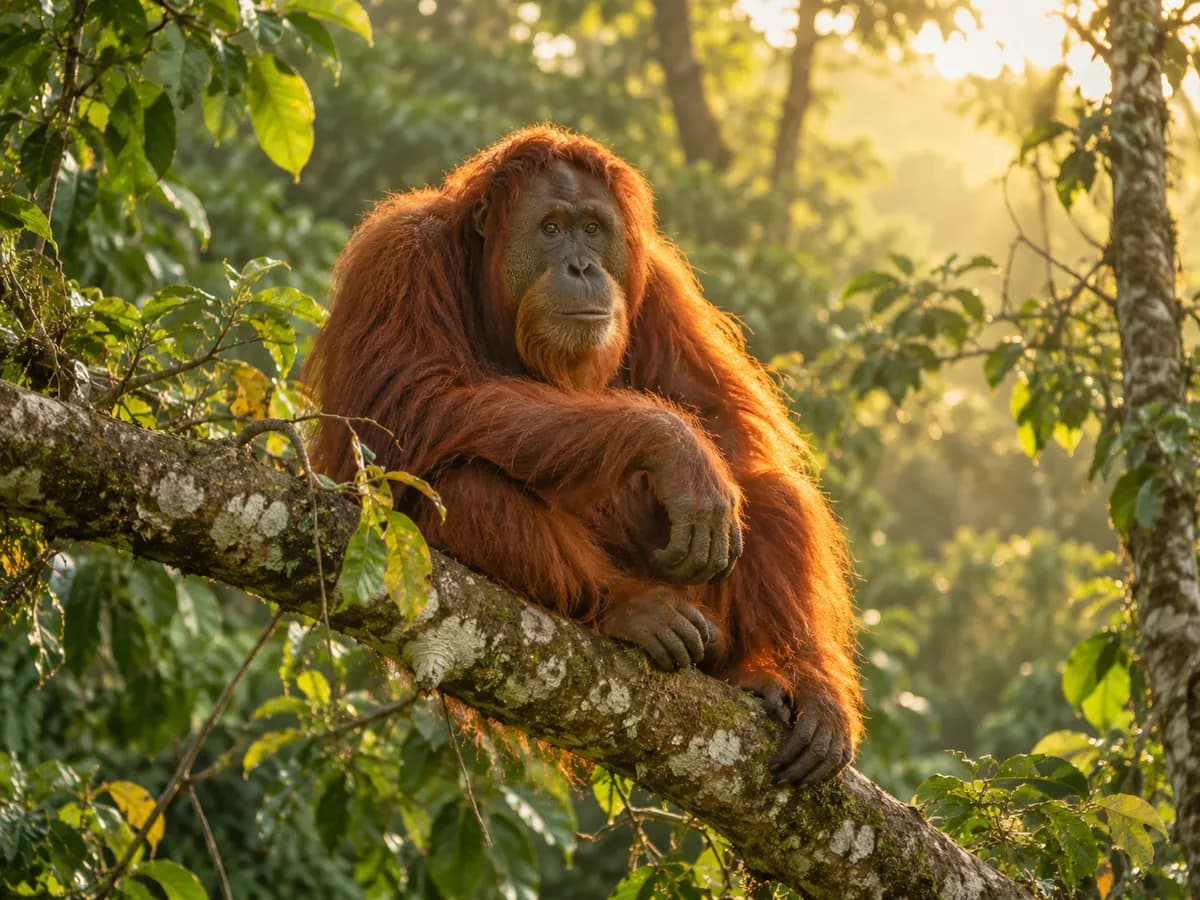
Orangutans (genus Pongo) are great apes known for their long reddish-brown hair and very long arms. Their name means "person of the forest" in Malay. There are three species: the Bornean orangutan, the Sumatran orangutan and the Tapanuli orangutan, described as a separate species in 2017.
Where does it live?
Orangutans live only in the rainforests of Borneo and Sumatra in Southeast Asia. They spend most of their lives high in the trees.
What does it eat?
Most of their diet is fruit; they especially like ripe fruit such as figs. They also eat leaves, bark, flowers, honey and insects. Remembering which trees fruit when is vital to their feeding.
Behaviour and social life
Orangutans are the most solitary of the great apes; apart from mothers and young, they mostly travel alone. Every evening they build a fresh nest of branches and leaves. They have been seen using large leaves as umbrellas against the rain and using sticks as tools.
Young
A female usually has a single young and cares for it for about 7–8 years. As a result, orangutans breed very slowly; a female may raise only a few young in her lifetime.
Conservation status
All three orangutan species are listed as Critically Endangered (CR) on the IUCN Red List. Destruction of forests for palm oil plantations, logging and mining, forest fires, hunting and the illegal pet trade are the main threats.
Fun facts
- An orangutan's arm span is much longer than its height.
- Some adult males develop large cheek pads called flanges.
- Orangutans are known for learning by observation and using tools.
Ähnliche Tiere
Weitere Tiere aus derselben Gruppe.
Respekt vor der Natur, ein stärkeres Morgen
Wildtiere zu schützen ist unser aller Verantwortung.
Wenn Sie ein verletztes oder junges Wildtier finden, fassen Sie es nicht an und informieren Sie die örtliche Naturschutzbehörde. Mehr Wissen, mehr Bewusstsein.
- Natürliche Lebensräume respektieren
- Wildtiere aus der Ferne beobachten
- Keinen Müll in der Natur lassen
- Eine nachhaltige Zukunft unterstützen