Cheetahs
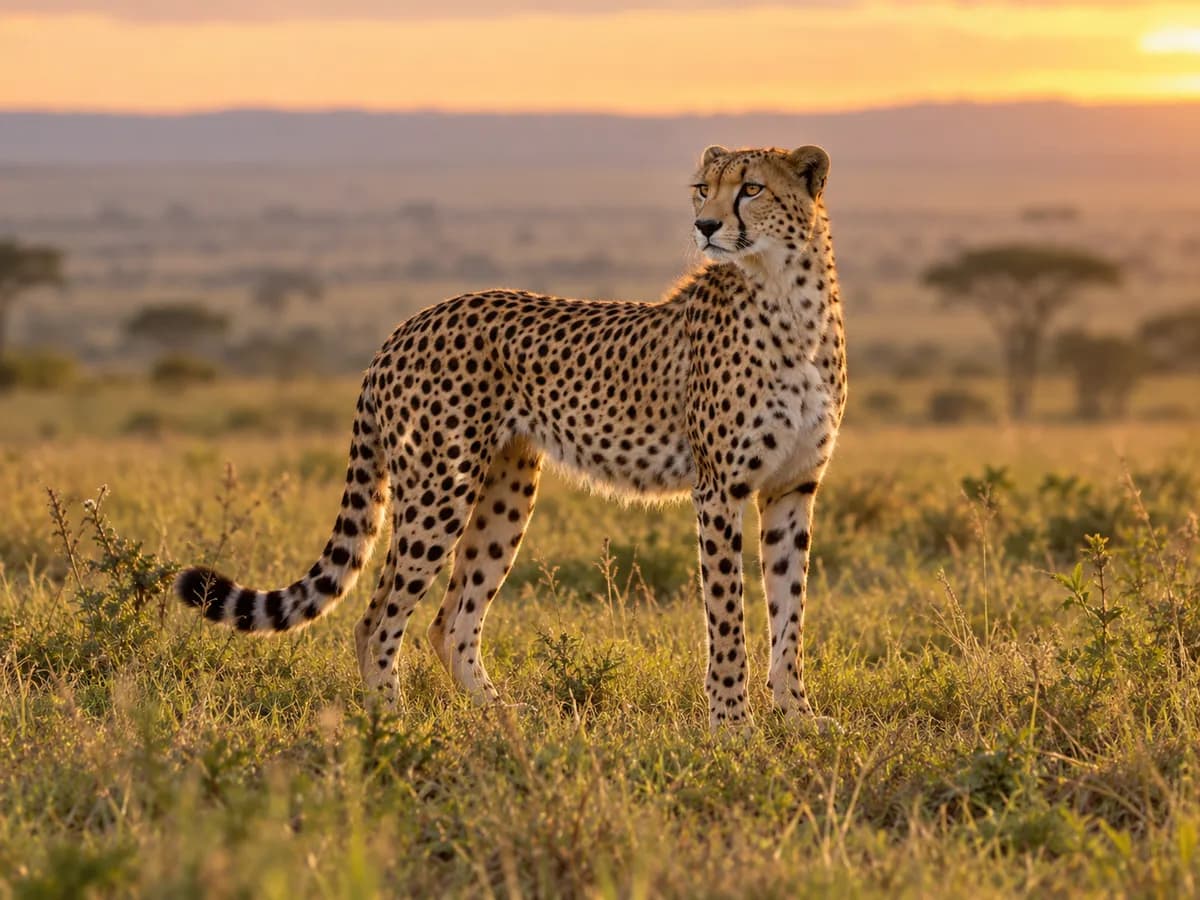
The fastest land animal, the cheetah can reach more than 100 kilometres per hour over short distances. Its slim build and the "tear marks" on its face set it apart from other big cats.
- Longueur
- 1,1–1,5 m
- Poids
- 21–72 kg
- Longévité dans la nature
- 10–12 ans
- Statut de conservation (UICN)
- Vulnérable (VU)
Valeurs approximatives pour les adultes ; elles varient selon le sexe, la sous-espèce et la population.
En un coup d'œil
Les faits essentiels sur Guépards.
- Where does it live?Most cheetahs live in the open savannas and grasslands of eastern and southern Africa.
- What does it eat?It is a carnivore that feeds on small and medium antelopes such as gazelles and impalas, as well as hares and birds.
- Behaviour and social lifeFemales usually live alone apart from their cubs.
- CubsAfter a pregnancy of about three months, a female has on average 3–5 cubs.
En détail
En bref
- The cheetah is the fastest animal on land.
- It can hold its top speed only over a short distance.
- It mostly hunts by day, which reduces encounters with lions and leopards that hunt at night.
- Unlike other big cats, it cannot roar; instead it makes chirping sounds.
- The IUCN lists the cheetah as Vulnerable; habitat loss and conflict with people are the main threats.
The cheetah (Acinonyx jubatus) is a slender, long-legged cat built for speed. The black "tear marks" running from the inner corners of its eyes to its mouth are thought to reduce the sun's glare and help it see prey.
Where does it live?
Most cheetahs live in the open savannas and grasslands of eastern and southern Africa. A very small population, the Asiatic cheetah, struggles to survive in Iran.
What does it eat?
It is a carnivore that feeds on small and medium antelopes such as gazelles and impalas, as well as hares and birds. It stalks close to its prey and then launches a short, very fast chase that usually ends within a few hundred metres.
Behaviour and social life
Females usually live alone apart from their cubs. Males often form small groups called coalitions, usually with their brothers. Cheetahs typically hunt by day, which lowers the risk of meeting lions and hyenas that are active at night. Even so, they often lose their kills to stronger predators.
Cubs
After a pregnancy of about three months, a female has on average 3–5 cubs. The long grey fur on the cubs' backs is thought to help protect them from predators. Cub mortality is high.
Conservation status
The cheetah is listed as Vulnerable (VU) on the IUCN Red List. Because cheetahs need very large areas, they are hit hard by fragmented habitat. Conflict with farmers and the illegal pet trade are also serious threats.
Fun facts
- A cheetah's claws are only partly retractable, which helps it grip the ground while running.
- Its long tail helps it balance during sharp turns.
- Cheetahs cannot roar, but they can purr.
Animaux similaires
D'autres animaux du même groupe.
Respect de la nature, des lendemains plus forts
Protéger la faune sauvage est l'affaire de tous.
Si vous trouvez un animal sauvage blessé ou un petit, ne le touchez pas et prévenez le service local de protection de la nature. Plus de savoir, plus de conscience.
- Respecter les habitats naturels
- Observer les animaux de loin
- Ne laisser aucun déchet dans la nature
- Soutenir un avenir durable