Loggerhead sea turtles
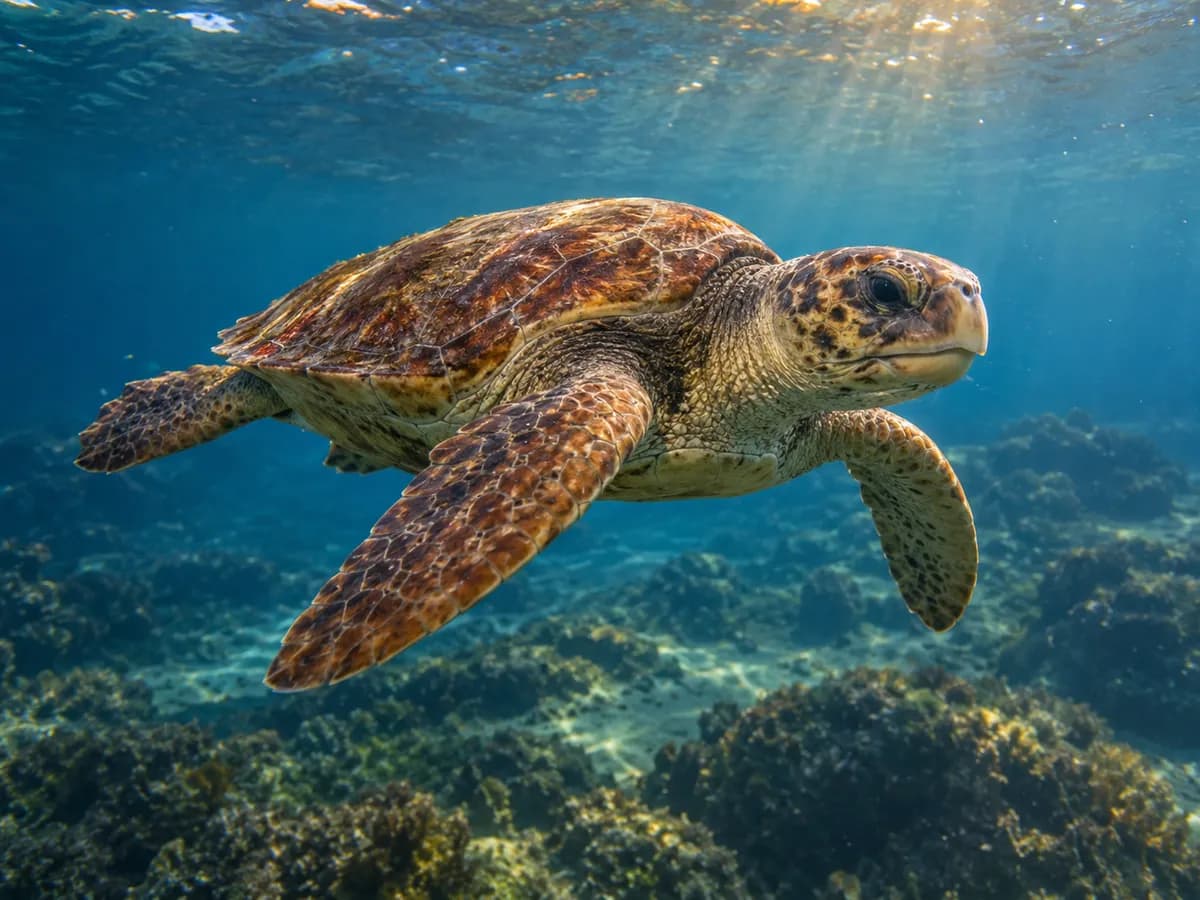
Known for its big head and strong jaws, the loggerhead sea turtle nests on beaches along Türkiye's Mediterranean and Aegean coasts. İztuzu beach at Dalyan is one of its best-known nesting sites.
- Longueur
- 0,7–1,1 m
- Poids
- 70–180 kg
- Longévité dans la nature
- 50–70 ans
- Statut de conservation (UICN)
- Vulnérable (VU)
Valeurs approximatives pour les adultes ; elles varient selon le sexe, la sous-espèce et la population.
En un coup d'œil
Les faits essentiels sur Tortues caouannes.
- Where does it live?It lives in temperate and tropical waters of the Atlantic, Pacific and Indian oceans and in the Mediterranean.
- What does it eat?It is a carnivore that eats crabs, mussels, sea snails, jellyfish and other invertebrates.
- Behaviour and lifeLoggerheads make long migrations across oceans over many years.
- HatchlingsA nest usually holds around a hundred eggs.
En détail
En bref
- The loggerhead is one of the world's most widespread hard-shelled sea turtles.
- In Türkiye it nests on beaches such as Dalyan, Patara, Belek and Fethiye.
- Females usually return to beaches in the region where they hatched to lay eggs.
- It crushes crabs and shellfish with its powerful jaws.
- The IUCN lists it as Vulnerable; coastal development, light pollution and fishing nets are the main threats.
The loggerhead sea turtle (Caretta caretta) is widely known in Türkiye by its scientific name, "Caretta caretta". It is recognisable by its reddish-brown shell and the large head that gives it its name. Powerful jaw muscles let it crush hard-shelled prey.
Where does it live?
It lives in temperate and tropical waters of the Atlantic, Pacific and Indian oceans and in the Mediterranean. In Türkiye, Dalyan (İztuzu), Patara, Fethiye, Belek, Çıralı and other Mediterranean and Aegean beaches are important nesting sites.
What does it eat?
It is a carnivore that eats crabs, mussels, sea snails, jellyfish and other invertebrates. Young turtles feed on small animals floating in the open sea.
Behaviour and life
Loggerheads make long migrations across oceans over many years. Females reach breeding age only after many years and usually return to beaches in the region where they hatched to lay their eggs. Nesting happens at night: the female crawls onto the beach, digs a pit in the sand, lays her eggs, covers them and returns to the sea.
Hatchlings
A nest usually holds around a hundred eggs. Sand temperature affects the sex of the hatchlings: warmer sand produces more females and cooler sand more males. After about two months the hatchlings emerge, usually at night, and head for the brighter horizon over the sea. Only a small fraction of hatchlings survive to adulthood.
Conservation status
The loggerhead is listed as Vulnerable (VU) globally on the IUCN Red List. Coastal development, light pollution on beaches (which disorients hatchlings), entanglement in fishing nets, plastic waste and climate change are the main threats. Many nesting beaches in Türkiye are protected.
Fun facts
- A female may nest several times in one breeding season.
- Swallowing plastic bags mistaken for jellyfish is a serious danger for sea turtles.
- Loggerheads are thought to use the Earth's magnetic field to navigate.
Bon à savoir
Les points les plus importants.
- On nesting beachesDuring the nesting season (roughly May to October), do not shine lights on beaches at night, watch out for marked nests before planting a beach umbrella, and never touch turtles that are nesting or heading to the sea.
Animaux similaires
D'autres animaux du même groupe.
Respect de la nature, des lendemains plus forts
Protéger la faune sauvage est l'affaire de tous.
Si vous trouvez un animal sauvage blessé ou un petit, ne le touchez pas et prévenez le service local de protection de la nature. Plus de savoir, plus de conscience.
- Respecter les habitats naturels
- Observer les animaux de loin
- Ne laisser aucun déchet dans la nature
- Soutenir un avenir durable