Seven-spot ladybirds
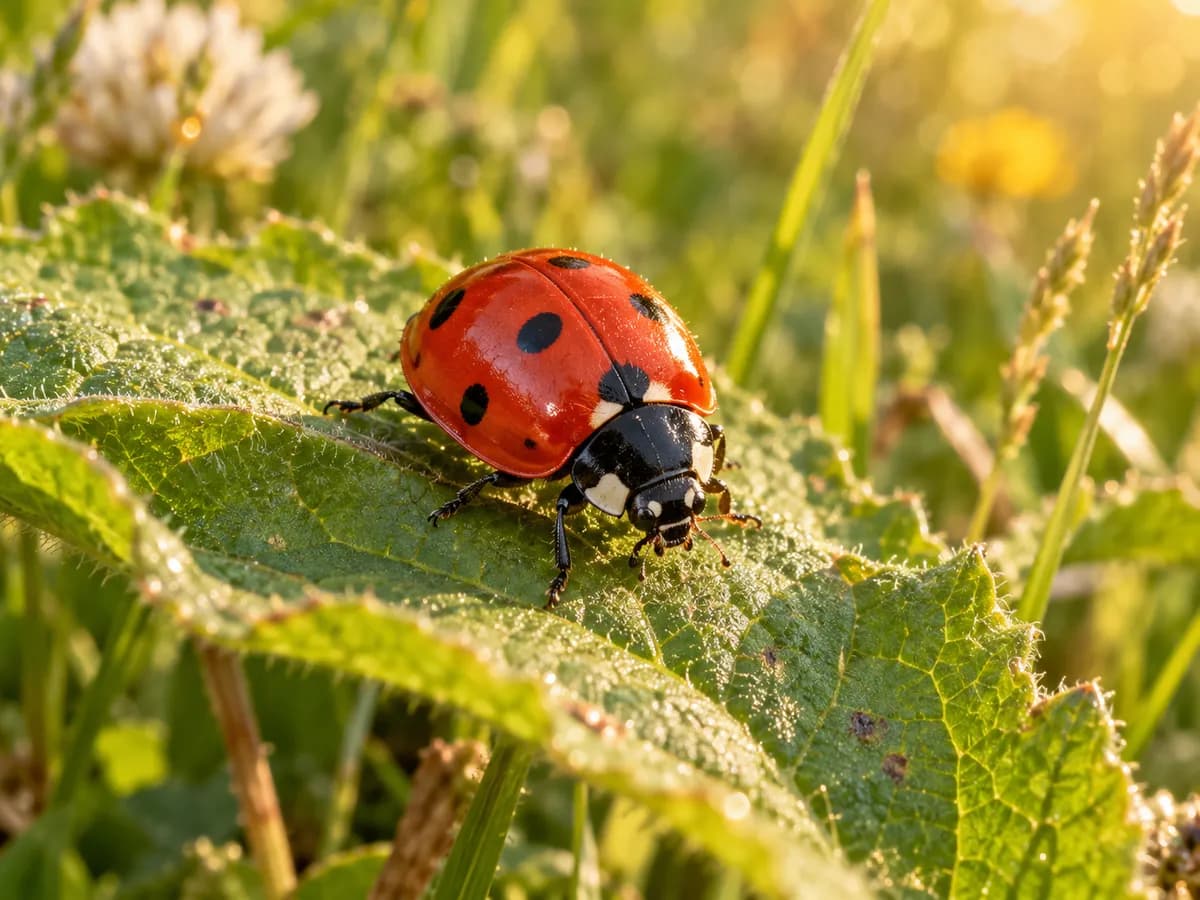
With seven black spots on its red wing cases, the seven-spot ladybird is one of the most familiar insects. Both adults and larvae help gardens by eating large numbers of aphids.
- Länge
- 5–8 mm
- Ernährung
- Insektenfresser
- Klasse
- Wirbelloses Tier
Die Werte gelten ungefähr für erwachsene Tiere und schwanken je nach Geschlecht, Unterart und Population.
Auf einen Blick
Die wichtigsten Fakten über Siebenpunkt-Marienkäfer.
- Where does it live?It is common in Europe, Asia and North Africa and has also been carried to North America.
- What does it eat?Both adults and larvae mainly eat aphids; a single ladybird can eat thousands of aphids in its lifetime.
- Behaviour and lifeWhen threatened, it releases a yellow, bitter fluid from its leg joints and may play dead.
- Life cycleThe female lays her eggs near aphid colonies.
Ausführlich
Kurz gesagt
- The seven-spot ladybird is one of the most common ladybirds in Europe and Asia.
- Both larvae and adults feed on aphids.
- Its bright colour tells predators it tastes bad.
- It spends the winter as an adult, often in groups in sheltered spots.
- It can be seen almost everywhere in Türkiye.
The seven-spot ladybird (Coccinella septempunctata) is a small beetle recognisable by the seven black spots on its red or orange wing cases. Under the wing cases are thin wings used for flying.
Where does it live?
It is common in Europe, Asia and North Africa and has also been carried to North America. It is found in meadows, fields, gardens and almost anywhere aphids occur.
What does it eat?
Both adults and larvae mainly eat aphids; a single ladybird can eat thousands of aphids in its lifetime. That is why it is known as a natural helper for pest control on farms and in gardens.
Behaviour and life
When threatened, it releases a yellow, bitter fluid from its leg joints and may play dead. Its bright colours tell birds it tastes bad. It spends the winter as an adult under bark, in leaf litter or in sheltered corners of buildings, often in groups.
Life cycle
The female lays her eggs near aphid colonies. The larvae that hatch look nothing like the adults, with long, spiny bodies. The larvae moult several times, pupate and then become adult ladybirds.
Conservation status
There is no global IUCN assessment for this species. It is common, but pesticides and, in some areas, competition with the invasive harlequin ladybird may affect native ladybird species.
Fun facts
- A ladybird's number of spots does not show its age; it depends on the species.
- In many cultures the ladybird is believed to bring good luck.
- Ladybirds fly by opening their wing cases and using the thin wings underneath.
Ähnliche Tiere
Weitere Tiere aus derselben Gruppe.
Respekt vor der Natur, ein stärkeres Morgen
Wildtiere zu schützen ist unser aller Verantwortung.
Wenn Sie ein verletztes oder junges Wildtier finden, fassen Sie es nicht an und informieren Sie die örtliche Naturschutzbehörde. Mehr Wissen, mehr Bewusstsein.
- Natürliche Lebensräume respektieren
- Wildtiere aus der Ferne beobachten
- Keinen Müll in der Natur lassen
- Eine nachhaltige Zukunft unterstützen